The Problem
If you are familiar with the origins of Rate It, you will know the idea came to me when my wife and I were in Baltimore going to different local restaurants. We were known as the foodies among our friends so we were often asked what places we’d recommend or what our favorites were. The issue is that we had gone to so many restaurants, they all started to blend together and we inevitably forgot some of the restaurants we enjoyed.
To solve our immediate problem of forgetting all the restaurants we had visited, my wife, Kathryn, created a shared Google Sheet. She listed all of the restaurants and created a 10 point scale consisting of three categories or rating tiers: food (5), service (3), atmosphere (2). The document consisted of three sheets, one sheet for Kathryn’s ratings, one sheet for my ratings, and an average between both our ratings. Now we not only had a list of all our restaurants, but using our ratings, we could actually stack rank them.
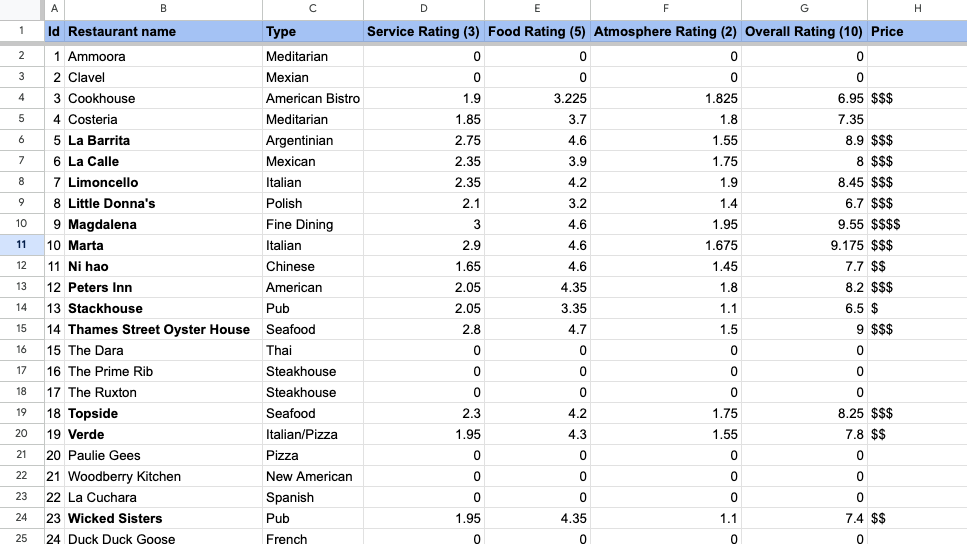
Over time, the management of the spreadsheet had become a pain and quickly fell out of date. As we were talking with other friends, I had come to find out they too had their own method of tracking the restaurants they liked. This is when I realized the opportunity and began researching what already existed. I started looking at the App Store for rating apps and couldn’t find anything that supported our needs. Other native restaurant reviewing sites or apps like Google Maps and Yelp were too focused on public perspective, meaning your personal ratings or ratings with friends got lost among the other reviews.
When I realized there wasn’t anything that met our needs and the needs of our friends, I started thinking through some solutions.
The Solution
When thinking of a solution to rate our favorite restaurants, I knew it had to be a native mobile app. The biggest friction with the spreadsheet was accessing it on our phones and inputting our ratings. It fell out of date because it was too much of an inconvenience to find the sheet, open it, and enter the data on our phone after our meal. The more time that had passed before entering our rating, the less likely we were to add our ratings. This meant the app had to be simple and easy to use.
I knew if I really wanted to grow this rating app idea, I had to first put it through its paces and do some additional thinking about the overall product strategy.
Differentiation
With the problem clear, I still needed to figure out why anyone would choose this over what already existed. When researching existing products and solutions, I found nothing with the flexibility of what I call rating tiers. Other apps let you provide a single rating or rank one thing against another, but we liked breaking a 10-point scale into three categories: food, service, and atmosphere. I knew this would be the most important differentiator for the product.
The other differentiator was the balance between private and communal. Most solutions solved for one or the other, but we wanted something in between — the ability to share and collaborate on ratings while staying selective about who saw them. Posting to a communal site loses the intimacy and trust of just sharing with family and friends.
Lastly, other apps were typically tailored to one specific rating category like restaurants, movies, beer, etc. When looking at our usage and the concept of the rating tiers, I realized this concept could be applied across any number of different categories. Generalizing the core concept would allow the product to expand into a larger total addressable market.
Defining the Users
As I thought about the total addressable market, I started to define different user groups, and this meant getting specific about what sharing actually meant. I realized influencer wasn’t just a label for someone with a public following. It was really anyone whose ratings other people wanted access to, whether that circle was five friends or fifty thousand followers. Kathryn and I were already doing a small version of this ourselves, since friends came to us for restaurant picks the same way followers come to an influencer for recommendations. The difference was scale and audience, not behavior, and that distinction became core to the product: you could rate privately or rate publicly, but the sharing instinct behind it stayed the same.
With that lens, three user groups emerged. The first is the influencer in the broad sense above — someone actively rating and posting, but without a dedicated place to collect it all in one easy-to-view list. The second is the follower: people who want to see what an influencer (or a trusted friend) has rated, for inspiration or a recommendation. The third is the private rater, who doesn’t want to share anything at all — just a structured, searchable alternative to a Notes app full of half-remembered restaurant names.
Monetization
After identifying the three groups of users, I began to outline the monetization strategy. I knew the app had to be free in some capacity; otherwise the growth of the app would be cut short. Looking at my groups of users, the free version would be perfect for the private rater. They can keep their ratings private and benefit from using the app.
To address the influencers and their followers, I needed to introduce a separate feature to allow users to share and collaborate. Given this was an extra feature, it made sense to productize it and charge users to share and collaborate on ratings with other users. I viewed the shared ratings as feature that is being unlocked which would create permanent data, so I decided to make it a one-time in-app purchase as opposed to a subscription. This was also determined based upon my internal evaluation of its value. Looking at other apps, the price of $4.99 seemed to make the most sense.
Go Time
By the time I’d worked through the problem, the differentiation, the target market, and the monetization model, I had more than an idea — I had a plan I could defend. I knew the gap was real because Kathryn and I had lived it. I knew the differentiator was real because nothing else on the market offered both the flexibility of custom rating tiers and the choice of private or shared use. And I knew there was a path to revenue that didn’t compromise the free experience for the users who just wanted a better version of their Notes app.
That’s what validation actually means at this stage — not a spreadsheet of market research, but confidence that the problem, the audience, and the business model all held up under scrutiny. From here, the work shifted from thinking to building.